
Why We Built leapwork.in
LEAPWORK.in started as a simple website with one goal: creating a place to share what we're building and why.
When we started working on Leap, one thing was clear from the beginning. We did not need a website just because every project is expected to have one. We needed a reason.
Leap itself began around a problem that many students in India face. Teenagers often struggle to access internships, early work experiences, and opportunities that help them explore their interests before college. While thinking about that problem and building around it, the question of a website naturally came up.
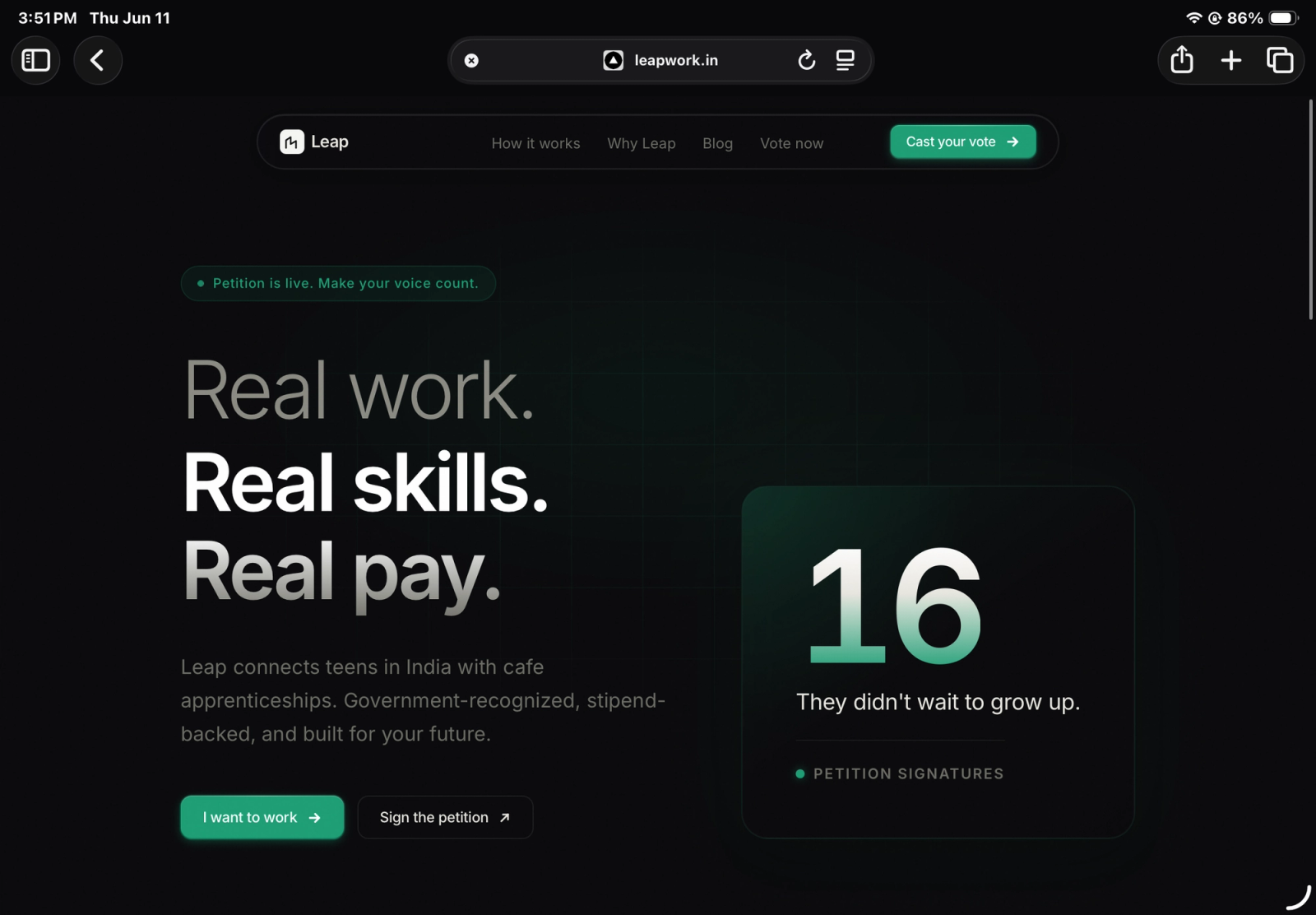
Before writing any code, I spent time thinking about what role the website would actually play. A lot of websites end up becoming collections of pages that exist because someone felt they had to create them. We wanted to avoid that.
The answer we arrived at was simple. We needed a place that belonged to us. A place where we could explain our ideas properly, share updates, publish content, and communicate directly without depending on social platforms or third-party spaces. The website did not need to do everything. It just needed to do its job well.
That decision shaped almost every choice that followed.
One of the easiest mistakes to make when building something new is trying to prepare for every future possibility. Features get added because they might be useful someday. Pages get created because they may become relevant later. Before long, a simple website becomes difficult to maintain.
We decided to take the opposite approach.
The first version of leapwork.in was intentionally small. Every page needed a purpose. Every section needed a reason to exist. If something was not useful right now, it could wait. We preferred having fewer things that worked well rather than more things that existed only to fill space.
Once we were clear about what we wanted to build, choosing the technology became much easier.
How LEAPWORK.in Is Structured
Flowchart
A high-level overview of how LEAPWORK serves content, manages users, and connects to the services that power the platform.
The website runs on Next.js and TypeScript. More importantly, it gives us a foundation that can grow without forcing us to rebuild everything later. While visitors only see a simple website, a lot of the technical decisions were made with future expansion in mind.
Authentication is handled through Clerk[1]. Even though the current website is lightweight, we know that the platform itself will eventually include broader functionality. By using Clerk early, we can make that transition smoother when the time comes. People who join us today should not have to go through unnecessary steps later because we made short-term decisions.
For content management, we ended up using both Sanity and Contentful[2]. This was not because we wanted a complicated setup. It was because each tool solved a different problem.
Sanity works well for managing site-wide content and configuration. Contentful gave us flexibility for editorial workflows without creating additional costs during the early stages. At this point, we care more about practicality than having a perfect architecture diagram. If a decision helps us move faster while keeping things manageable, it is usually worth considering.
The same thinking applied to infrastructure.
Leap is part of IBBE, which means we already have systems and services that can be shared across projects. Instead of creating separate infrastructure for the sake of independence, we built on top of what already existed. Email delivery runs through Amazon SES[3] and many supporting services follow the same principle. Reusing proven systems often makes more sense than starting from scratch.
The website is hosted on Vercel, largely because it makes iteration easier. Building a website is rarely a straight path. Features change. Designs evolve. Mistakes happen. Having preview deployments and straightforward workflows allows us to test ideas quickly without creating unnecessary risk.
Looking back, the most important decision was probably not a technical one.

FROM THE FOUNDERS
The platform provides a beautifully simple, dedicated space for our community. As we continue to develop and introduce new features, our core mission remains the same: empowering students throughout India to unlock their true potential.
FROM THE FOUNDERS
Leapwork.in gave us the perfect interface for our project. It’s beautifully concise and doesn't confuse users. Exactly what we were looking for
01/02
It was deciding to keep the website focused.
There is always pressure to launch bigger, add more features, and make things look more impressive than they really are. We tried to resist that pressure. At this stage, clarity matters more than scale. A visitor should understand who we are, what we are working on, and how they can be part of it. If the website accomplishes that, then it is doing its job.
The website today is not the final version, and it is not supposed to be. Like the project itself, it will continue to change as we learn more, build more, and understand our users better. What matters is that it gives us a starting point and a place to build from.
Sometimes that is enough. Not every product needs to begin with a complex platform. Sometimes it starts with a simple website, a clear idea, and a willingness to keep improving it one step at a time.
References
- 01
Clerk was selected with future platform expansion in mind, allowing waitlist users to transition into platform users more smoothly.
- 02
Sanity is used for site configuration and structured content management, while Contentful is used for editorial workflows and content publishing.
- 03
Amazon SES (Simple Email Service) is AWS's email delivery service used to send automated emails from applications and websites.