
When. Your time, perfectly scheduled.
When. Sovereign scheduling for Vercel. Open-source, elegantly simple, and entirely yours. A more personal way to connect.
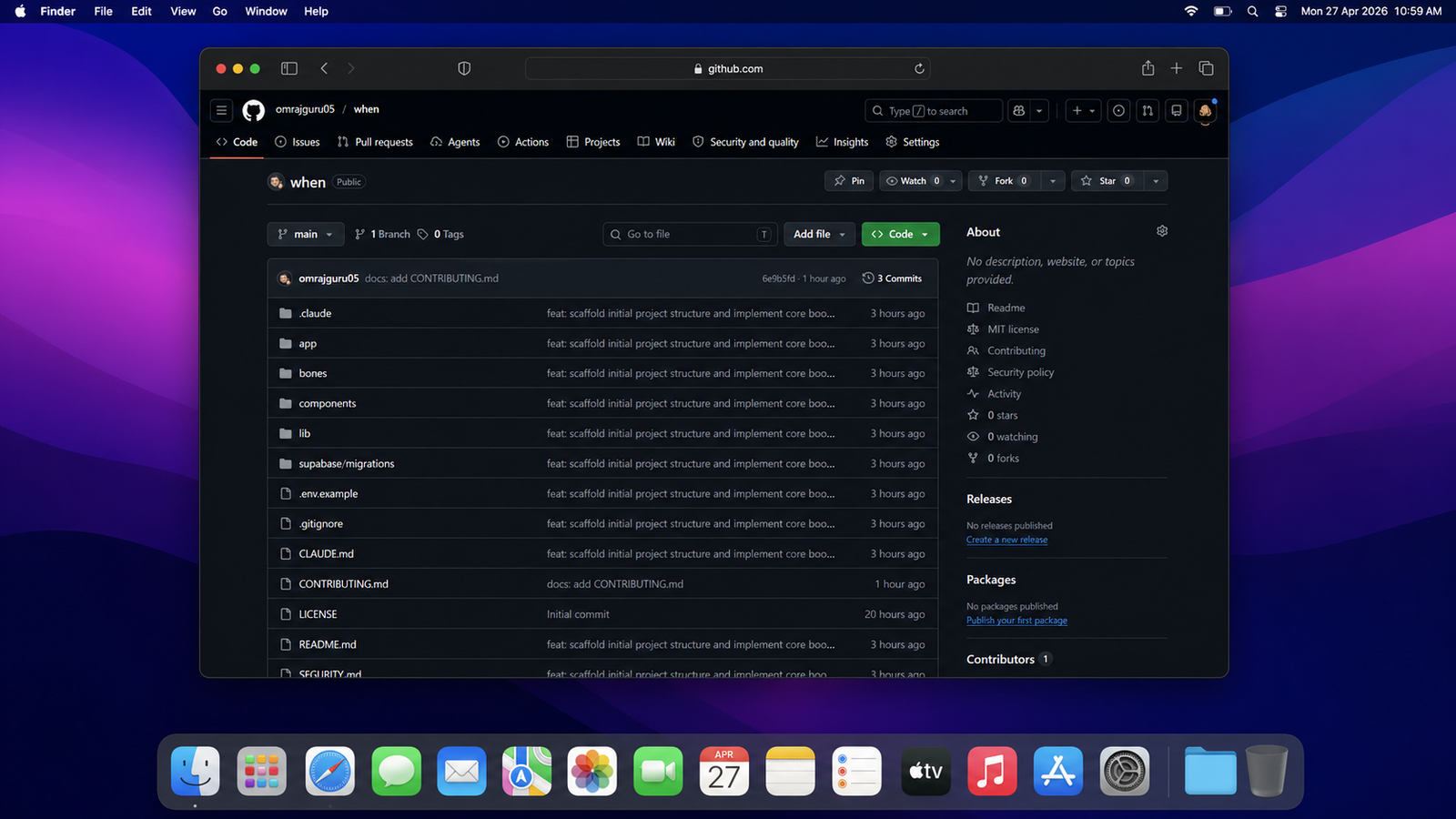
Time is the most personal thing we own. It is the silent architect of our days and the measure of our commitments to others. When we look at our calendars, we should see opportunity rather than a list of tasks. For too long, the tools designed to help us manage this resource have felt disconnected from the people who actually use them. They are often built with the enterprise in mind, filled with complexity that obscures the simple act of meeting. We wanted to return to a sense of clarity and purpose in how we share our availability. This required a fundamental rethink of what a scheduling platform should be. It should be light, it should be yours, and it should be profoundly simple to maintain.
The journey began with a simple search for a platform that could live where developers already spend their time. Vercel has become the home for modern web applications, offering a free tier that empowers creators to launch their ideas instantly. However, we discovered a recurring theme among existing scheduling solutions that made them difficult to adopt. Most were built with architectures that exceeded the limitations of a hobbyist account. They relied on intensive cron jobs or excessive serverless functions that forced a move to paid tiers before the first booking was even made. This created a barrier for students, independent creators, and those just starting their journey. We felt there was a need for something that respected these constraints while delivering a premium experience.
The result of that exploration is a project we simply call when. It is an open source scheduling platform that prioritizes sovereignty and accessibility above all else. By making the code available to everyone, we ensure that the infrastructure of your time is owned by you. There are no hidden fees or tiers of service that gatekeep the features you need to run your life. You can host it yourself, look at the logic behind every booking, and change it to fit your specific needs. This level of transparency is rare in a world where software is often a black box. We believe that when you own the tool, you feel more confident in the work you do with it. It is a tool built by developers, for the people who appreciate the craft of clean code.
To make this vision a reality, we chose a stack that is both powerful and approachable. By connecting Supabase, Resend, and the Google Calendar API, we have created a system that is resilient and easy to deploy. Supabase provides the foundation for your data and authentication, ensuring that your information is handled with care. Resend manages the delicate task of communication, delivering confirmations and notifications with precision. The Google Calendar API acts as the bridge between your digital life and your actual availability. These services work together in a quiet harmony that allows you to focus on your meetings rather than the plumbing of the internet. It takes only a few minutes to set up, but the impact on your productivity lasts much longer.
| Service | Purpose | Requirement |
|---|---|---|
| Vercel | Hosting & Deployment | Hobby Plan (Free) |
| Supabase | Database & Auth | Project URL & API Keys |
| Google Cloud | Calendar Integration | OAuth Credentials |
| Resend | Email Delivery | API Key |
Security and privacy are not features to be added later; they are the starting point for every line of code we write. We implemented magic link and Google sign in through Supabase Auth to ensure that your entry into the dashboard is as smooth as it is secure. There is no need for extra authentication services that complicate the architecture or store your data in multiple places. Everything is contained within your own environment, giving you total control over who has access to your scheduling data. We believe that your identity should belong to you, and your tools should respect that boundary. By using modern standards for authentication, we provide a professional experience that does not compromise on the safety of your personal or professional information.
The booking experience itself is where the design of when truly shines. Your public booking page is clean, responsive, and automatically adapts to the visitor's timezone. This eliminates the awkward mental math that often accompanies international meetings. Whether someone is visiting your main profile or a specific event link, they are met with a clear view of when you are actually free. There is a certain beauty in a page that only shows what is necessary. We have removed the clutter of traditional scheduling interfaces to focus on the human connection at the heart of the appointment. It is an invitation to connect, presented with the quiet confidence that your time is being managed with the utmost care.
Managing your availability should be an intuitive process that reflects the reality of your life. With when, you can set weekly hours that define your standard routine, but we also know that life is rarely standard. That is why we included the ability to block specific dates and add buffer times between meetings. These small details prevent the burnout that comes from back to back sessions and gives you the space to breathe. You can also set a minimum notice period so that no one can surprise you with a meeting at the last minute. These rules are not just settings; they are the boundaries you set for your own well-being. They ensure that your calendar works for you, rather than the other way around.
“My favorite things in life don't cost any money. It’s really clear that the most precious resource we all have is time.”
—Steve Jobs,Co-founder of Apple
Every meeting is different, and your scheduling tool should reflect that variety. You can create multiple event types, each with its own unique link and duration. Whether it is a quick fifteen minute check in or a deep dive hour long session, you have the flexibility to define the terms. You can even customize the questions you ask before a booking is confirmed. This allows you to gather the context you need to make every meeting productive from the very first second. The ability to color code and describe these events adds a layer of organization that makes your dashboard a joy to use. It is a level of personalization that makes the tool feel like an extension of your own professional brand.
Synchronization is the silent engine that keeps your schedule accurate. By integrating with Google Calendar, when can read your existing busy slots and write new events as they are booked. We have handled the complexities of refresh tokens so that you never have to worry about your connection dropping. This two way sync ensures that you are never double booked, even if you add a personal appointment to your calendar manually. It is the peace of mind that comes from knowing your digital assistant is always watching your back. The technology fades into the background, leaving you with a single, reliable source of truth for your time. This is how modern tools should function: with intelligence and without constant supervision.
Communication is essential to a successful meeting, and our integration with Resend ensures that nothing is lost in translation. Every time a booking is made, both the host and the visitor receive clear, beautiful email confirmations. These are not just automated messages; they are the first step in a professional interaction. If plans change, the system handles cancellations with the same level of grace. We have included a signed URL in every email that allows for one click cancellations without requiring a login. This respects the time of your visitors and makes the process of rescheduling as painless as possible. It is a thoughtful approach to the reality that life is often unpredictable and plans frequently need to change.
There is a distinct elegance in working within limits. We embraced the constraint of twelve serverless functions on the Vercel hobby plan as a creative challenge. Currently, the project uses eleven, which required us to think deeply about the architecture of our route handlers. We chose to collapse related operations into single files to ensure the platform remains accessible to everyone without any financial cost. This discipline in engineering results in a faster, more efficient application that is easier to maintain. It is a testament to the idea that you do not need an oversized infrastructure to build something of great value. Every file in the repository has a clear purpose and a justified place in the overall system.
The future of when is being written by the community that uses it. Because the project is fully open source, every contribution helps to refine the experience for everyone else. Whether it is a bug fix, a new feature, or a clarification in the documentation, your input is what drives the project forward. We have created a space where technical discussions are productive and every voice is heard. The platform will be stabilized and available for general use in just a week, but the journey of improvement never truly ends. We invite you to explore the code, host it for yourself, and join us in building a better way to manage our most precious resource. This is more than just a tool; it is a shared commitment to a more thoughtful way of working.